
His Holiness to Visit Japan!
Note: The following is from a press release by the Liaison Office of H.H.the Dalai Lama, Tokyo.
Tokyo, Japan April 5 – His Holiness the Dalai Lama will arrive in Tokyo on 8 April for an eleven day visit to Japan. His Holiness will give a public lecture titled ‘Compassion in Human Relations’ at Ryogoku Kukugikan, in Tokyo in the afternoon of 9 April 2005.
His Holiness has been invited by Rengein Tanjyouji, Tamana city, Kumamoto Prefecture. He will be there from 10 to 14 April 2005. His programme in Kumamoto prefecture include a public lecture on "world peace through peaceful heart" at Kumamoto Prefecture Theatre, visit to Aso shrine, a public talk to the staff and students of Kyushu University of Nursing, a Buddhist teachings at Okun-in branch temple of Rengein, and a fire puja at Regein Tanjyouji main Temple.
From there His Holiness will leave for Kanazawa prefecture where His Holiness will give two-day public teaching on Buddhist philosophy on 16 and 17 April 2005. The teaching is hosted by Busshokai. Busshokai has hosted several teaching by His Holiness in the past including Kalachakra teachings in India and America. As else where, there is tremendous interest in His Holiness the Dalai Lama and his message of loving kindness and compassion in Japan and in the neibouring countries. All seats in all public talks in all three cities, Tokyo, Kumamoto and Kanazawa have been sold out. A couple of hundred of Korean Buddhists as well as several Buddhist from Taiwan and Hongkong are expected to attend His Holiness teachings.
On 8 April, in the afternoon of his arrival, His Holiness will pay a visit to Majie Shrine in Tokyo, which is the most important Shinto Shrine.Similarly will make a stop over visit at Nishi Ongangji in Kyoto, one of the most important Buddhist manasteries in Japan on his way to Tokyo on 18 April 2005. The pilgrimage to these two very highly significant place of spirituality are in line with His Holiness the Dalai Lama’s wish to bring harmony and respect between different religious faiths and that of different tradition of the teachings of Lord Buddha for the common good of humanity. His Holiness will be received by the Chief Priest of Majie Shrine and by the Monshu, The Grand Abbot of Nishi Ongangji respectively.
His Holiness the Dalai Lama will return to India on 19 April 2005. This will be His Holiness the Dalai Lama’s 10th visit to Japan but 14th including four brief transit stops.
# # #
Spring Brizzzy, cont.
Ohhh well… Since I must be here, might as well create an Elementary School English curriculum. This Spring Break the city ALTs (those of us that are not taking vacation) have been assigned the task of creating an Elementary School English curriculum. Beginning in April, all the city ALTs will be visiting elementary schools once a week. Therefore, creating some form of guideline is necessary to prevent some ALTs from teaching Poker jargon as an English lesson idea… In my opinion, I think this is a pretty big project, because teaching English elementary schools is a relatively new trend in the Japanese educational system. Sending ALTs to elementary schools on a weekly basis is a huge change in a system that has no present guidelines for this, other than the one we are now creating. The future of Tokushima’s Japanese Elementary School English education is in our hands…
Spring Brizzzzy…
Well, it’s spring break! However, this no longer involves a break for me and the other JETs working for the Tokushima City Board of Education (BOE). Unlike previous years, ALTs are now required to work during these periods of no school. This is a pretty drastic change, so there’s been talk of non-violent protests, but I’m for a more peaceful resolution. I’ll be talking to the Prime Minister later over the phone, hopefully we can get this resolved so I can get back to sitting around my apartment and relaxing over the breaks again. More to follow…
Today and tomorrow, myself and 4 other ALTs are attending a high school English camp of sort. The camp involves teaching English workshops to high school students that are interested in advancing their English skills. Each ALT is to focus their lesson of choice on a specific theme, ie: listening, reading, writing, speaking. This was my first experience teaching high school students and for the most part things are going well….
Closing Ceremony!
Today was the JHS closing ceremony. The closing ceremony marks that last day of the academic school year. Although the 9th graders have graduated and no longer attend school, 7th and 8th graders prepare to move onto the next grade. March is an unusual time to end the school year, but the reasoning can vary depending on who you ask. From my understanding, the end of March to early April marks the beginning of spring. This is a very important time of the year in Japan as beautiful cherry blossoms trees are in full bloom symbolizing a chance to start fresh. However, a chance to relish a fresh start is short lived as the next school year begins on April 8th.
The closing ceremony is also an opportunity to say sayonara to many teachers. As previously mentioned in an earlier blog, Japanese teachers often move from school to school after a few years. The final decision regarding changes is made by a central board of education, which oversees all teachers in their respective prefectures. Sadly, a number of great teachers will be leaving after today, including Nakasono-sensei, a Japanese English Teacher (JTE) that I’ve taught a lot of classes together with. Tonight is the final enkai (party) of the school year. The sayonara enkai is usually one of the better parties in the year, so I’m looking forward to it. Heavy drinking to commence in under 7 hours and countdown…
8th Grade Dodge Ball Championships!
Yesterday I played a little Dodge Ball in the gym with the 8th graders. This was no ordinary day in PE class though, this was the annual 8th grade championships! Dodge Ball is huge among elementary and JHS kids in Japan! It’s also played a little different than my days growing up. Using the techniques I’ve learned from my days dominating the US JHS circuit; while picking up on the differences in rules in Japan – I’ve now become an international Dodge Ball killing machine! For yesterday’s tournament, I was placed on one of the weaker classes. This was OK, as my only focus was to use my size and strength to push every person in my way to the side as I attempted to take over the game on my team’s behalf. Using my cat-like reflexes, I was able to dodge balls that would have hit any average player. Every opportunity I got the ball, I unleashed a Randy Johnson fastball in the direction of a JHS’s students head with heat-seeking precision. I desperately attempted to go it alone, running over every person on my team, pleading with my teammates to “let the Unit throw it!” In the end, all my effort was for nothing as class 2-2 lost in the first-round! After the game, I gathered my team together in an effort to console the players and told them what any sympathizing teacher on a mission to win would have said, “you guys need to hit the weight room!”
Elementary School Graduation!
Today I attended my first elementary school graduation in Japan! Unique from the junior high schools, elementary school graduations are a much more intimate event. Depending on the size of the school, most students are not recognized individualy at the JHS level. However, at today’s elementary school graduation, each 6th grader received their diploma personally from the school principal. After which, every attempt to make teachers, students and their parents cry was made. Each 6th grader had a part in a class speech thanking everyone in attendance, including the school cooks. Then the teachers thanked the students, followed by the PTA thanking teachers, then the 5th graders thanked the 6th graders, and then songs were sung in every direction. If there wasn’t anyone crying at this point, a slide show was added for good measure, as the students left the gym to instruments played by the entire 4th and 5th grade. In the end, mission accomplished – everyone left the ceremony wiping away tears.
Jr. High School Graduation Ceremony!
Today was the Jr. High School graduation ceremony! This is the second Jr. High School graduation I’ve attended. Japanese Jr. High School graduations are somewhat different from those back home, but the reason for celebrating is universal. Graduations are an opportunity for teachers to say bye and vis versa for students. In Japan, students are lead by a selected homeroom teacher throughout the school year. This teacher provides students important daily announcements, as well discipline when needed amongst a myriad of other responsibilities. Almost a father or mother figure at times, this teacher proudly leads his or her class into the gym on graduation day. Special graduation guests are introduced, speeches are given by the principal and student leaders, songs are sung and in the end – most girls and their mothers can be seen crying. A parade of sort is made through the school gates, which marks the end of the ceremony.
Tenzing and Jeanie in Japan!
Well… Tenzing and Jeanie have come and gone – and speaking on their behalf – I’d like to say they had the time of their lives visiting Japan. Their trip was very exhausting for all of us, as each day was action packed. At their request, I won’t be posting too many pics online or go into too much detail about their visit, but all in all it was pretty memorable. In their week in Japan we visited Osaka (the big city), Tokushima (my city) and Kyoto (the old city). In addition to an endless amount of sightseeing, we took part in many traditional Japanese cultural activities, as well as visited two of my schools – where they were classroom guests. A BIG thanks to the soon to be married couple for coming out to Japan and visiting me, see you guys in July at the wedding!
Ikeda Sake Festival
This past weekend I went to the Sake Festival in Ikeda – a small town in western Tokushima. This festival started at 10:00 am and ended at 3:00 pm. For about 10.00 US dollars, I was given a small sake glass and was allowed to sample an endless variety of different sakes. At any point, a sake taste test could be taken where 6 different sakes are to be matched with 7 possibilities. This test was difficult as I only made one match. After spending 3 hours sipping on sake, I went to two local sake breweries to sample and see how sake is made.
Five crucial elements are involved in brewing sake — water, rice, technical skill, yeast, and land/ weather. More than anything else, sake is a result of a brewing process that uses rice and lots of water. In fact, water comprises as much as 80% of the final product, so fine water and fine rice are natural prerequisites if one hopes to brew great sake.
The first step in making sake is with the rice, where it is washed and steam-cooked. This is then mixed with yeast and koji (rice cultivated with a mold known technically as aspergillus oryzae). The whole mix is then allowed to ferment, with more rice, koji, and water added in three batches over four days. This fermentation, which occurs in a large tank, is called shikomi. The quality of the rice, the degree to which the koji mold has propagated, temperature variations, and other factors are different for each shikomi. This mash is allowed to sit from 18 to 32 days, after which it is pressed, filtered and blended.
The Big Turnip
Every Friday I visit an elementary school where I teach 3-4 classes per day. For the time being, there is no formal English curriculum at the elementary school level in Japan. However, there appear to be slow changes on the horizon. Visiting elementary schools are a lot of fun, but also require a lot more planning than teaching at Jr. High Schools. Because there is no set curriculum, JETs are usually free to teach what ever they wish.
This past Friday was an exciting day! The first grade elementary school students and I have been working on a play, “The Big Turnip” and today was show-time! If you don’t know the story of “The Big Turnip,” you need to read more. It’s a NY Times Best Selling story about a grandfather who grows a turnip and then the turnip grows so big he needs other people to help him pull the turnip out from under the ground, including the strength of the town mouse to complete the task. Our audience consisted of kindergarteners, next year’s first graders. Here’s a few lines from the award winning play!..
The Big Turnip
Grandpa: “Sweet, Sweet – Big, Big – Turnip! – Pull! Pull! – Pull! Pull!!”
Turnip: “Noooo, not yet!”
Grandpa: “Grandma, please help me!”
Grandma: “Oh, o.k.”
Grandpa and Grandma: “Let’s pull! Pull! Pull! – Pull! Pull! – Oh no!”
Turnip: “Nooo, not yet!”
Grandma: “Grandaughter, please help us!”
Valentine’s Day
Today is Valentine’s Day. Valentine’s Day is celebrated a little differently in Japan. On February 14th, only the women give presents – mainly chocolate – to men. Men are supposed to return the favor received on a second Valentine’s Day one month later (March 14th) called White Day, a Japanese creation.
Valentine’s Day was imported to Japan in 1958 by a Japanese confectionery company and these guys must of have been geniuses. I say guys, because they must have been thinking on behalf of all men when they dreamed this baby up. To force a woman to play her card in February, providing one full month for men to match or exceed the kindness is brilliant! Another reason, why Japan is a man’s society.
Teaching Demonstration
Every year, the Board of Education selects a different Jr. High School in Tokushima City to present a English team teaching demonstration. Yesterday, the lesson was at my school. After a lot of preparation between myself and the Japanese Teacher of English (JTE), it was finally show time! About 20 people showed up to watch our demonstration, which was followed by a meeting to evaluate our pros and cons. All in all, the day was a success I think! Mostly kudos, with some minor constructive criticism. In the evening, we had a small enkai.
Setsubun
Today is Setsubun, a Japanese festival held on February 3rd or 4th, but always one day before the start of spring according to the Japanese lunar calendar. For many centuries, the people of Japan have been performing rituals with the purpose of chasing away evil spirits at the start of spring. The most commonly performed setsubun ritual is the throwing of roasted beans ‘out’ and ‘into’ one’s house. When throwing the beans, you shout, "Oni wa soto! ("Out with the bad/demons!") Fuku wa uchi!" ("In with the good!"). Afterwards it’s common to pick up and eat the number of beans, which corresponds to your age.
Human Rights Lecture
Recently I was asked by the teachers at the junior high school I teach at to be a guest speaker on the topic of human rights. This was a great opportunity to share with students in Japan about the struggle that Tibetans face every day at the hands of Chinese communism oppression.
Tibet: An Overview
FREE TIBET!
I’m sure you’ve heard it before, now here’s what it means. Take a minute to learn about the struggle of the Tibetan people. Thank you.
Tibet is an occupied country. This is the most important fact to remember when working for Tibetan freedom. We are not simply working for human rights or religious freedom in Tibet, we are working to free a nation from a illegal and brutal foreign occupation. At the time when Chinese troops invaded Tibet in 1949, Tibet was an independent nation. Tibet had its own government, its own language, its own currency, its own postal system and its own legal system. When we say "Free Tibet" we don’t just mean, "Make things better in Tibet." We mean "Free the nation of Tibet from Chinese occupation."
China’s People’s Liberation Army took Tibet by force. When Chairman Mao came to power in 1949, one of the first things he did was send his troops to annex Tibet. Tibet did not have a large or well-equipped army. While there was a determined armed resistance to the Chinese invasion, the relatively small Tibetan army was eventually crushed by the Chinese army. An agreement was imposed on the Tibetan government in May of 1951, acknowledging sovereignty over Tibet but recognizing the Tibetan government’s autonomy with respect to Tibet’s internal affairs. As the Chinese consolidated their control, they repeatedly violated the treaty and open resistance to their rule grew.
By 1959, the situation had become dire in Tibet. Thousands of Tibetan refugees poured into western Tibet from the east, where Tibetan resistance fighters were engaged in open battle with the Chinese army. Massive demonstrations broke out in Lhasa, Tibet’s capital, when rumors that the Dalai Lama’s life was in danger began to circulate. Tenzin Gyatso, Tibet’s 14th Dalai Lama, is the spiritual and political leader of Tibet. In 1959, he was only 24 years old. On March 10th 1959, hundreds of thousands of Tibetans massed around the Norbulingka Palace, the Dalai Lama’s summer residence, to prevent him from attending an event to which the Chinese authorities had invited him. They feared he might be killed secretively. The demonstrators called for Tibetan independence and for Chinese forces to leave Tibet. When the situation became tense, the Dalai Lama fled under cover of darkness on March 17, 1959 to India, where he has lived since. Tens of thousands of Tibetans were killed by Chinese forces who broke up the mass protests.
Since 1959, Tibet has been solely under Chinese rule. The Tibetan people both inside Tibet and in exile long for the Dalai Lama to return to Tibet to resume his rightful place as Tibet’s leader.
Watch a little of the award winning documentary, Tibet – The Cry of the Snow Lion (link provided below):
The Portland Dynasty: Taking Tibetan Basketball Over!
This story was featured as a cover story in Tibetan World Magazine. It chronicles the story of my basketball team from Portland, OR (USA).
January 2005: Volume 1, Issue 7
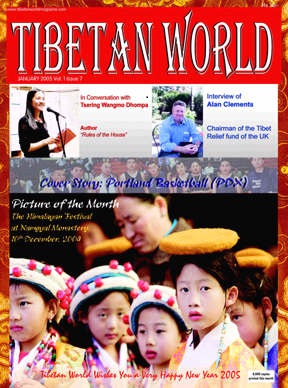
The Portland Dynasty
Taking Tibetan Basketball Over!
A conversation about Tibetan basketball is incomplete without mention of the undefeated Portland ‘A’ basketball team, a.k.a. PDX. Just in case you are wondering who they are then let me share with you the story of PDX from the Pacific Northwest that have been dominating Tibetan hoops for almost half a decade. After four consecutive Tibetan West Coast Picnic (WCP) championships, word of Portland’s Dynasty has spread across Tibetan communities worldwide faster than a pair of classic Air Jordan’s. From the past, to the present and a look into the future, this is the story of the Portland ‘A’ basketball team. If you thought you knew, you had no idea.
The Dynasty – past
The Portland chemistry is a formula that may be hard to recreate, because this team learned the meaning of teamwork from their families over 40 years ago. Many of their parents immigrated to the United States in the late 1960s. At the time there were a limited number of Tibetans in the United States. Their parents were the first to lay roots in northwestern Oregon and began raising children in the 1970s. Although some families lived hours away from each other, gatherings took place occasionally to celebrate many Tibetan cultural events. In addition to Tibetan holidays, their children’s birthdays were an opportunity for celebration for this once small community. In 1984, the community hosted the first of two visits the Dalai Lama made to Oregon.
The Dynasty begins – the present run of championships/event overview
Having spent a large portion of their childhood together, PDX members spent their late teenage years apart. Many members of the team attended different high schools and it wasn’t until 2001 when discussion began to start a basketball team. Ever since the team was formulated for the WCP championships in Seattle, there has been no looking back. The Portland ‘A’ team consists of players: 8 born in United States, 2 born in India, and one born in Nepal. Their chemistry on the court can be attributed to years of competing against each other in various sports while growing up. In the summer of 2001 they began focusing their energy collectively and thus, the Dynasty began. This event (WCP), which is held every year over the first weekend of July to celebrate the Dalai Lama’s birthday, consists of cultural shows and talent competitions. On top of these two programs, it is a great way for Tibetans to meet and bond with each other, a good means to raise awareness, and families use it as a reunion purpose. Recently sporting events have been introduced and over the years they have grown to wild popularity from all ages.
Sports teams from all over the western United States as well as the Midwest and Canada are attracted to this event for one single reason – to be a part of “history in the making”.
2001: At the 2001 WCP in Seattle, PDX burst onto the scene by beating Toronto 54-27 in the first round, Portland’s own ‘B’ team 66-24 and eventually Vancouver, B.C. in the finals. Vancouver, B.C., who were once WCP champions in 1998 lost to Portland “A” in overtime. In the years to follow, PDX would demolish teams with no remorse. At the same time, family members from opposing teams would know the outcome before the games even started and were only left to hope their sons would keep it competitive.
2002: In 2002, Portland had home-court advantage for the first time during their run of championships. As the host city, expectations were high for a repeat and the team would not disappoint. Portland drew the 1999 WCP champions, Seattle in the first round. This match-up of players very familiar with one another was expected to help Seattle; however, PDX would crush the former champions 38-13. The second round would be more of a challenge, as a determined Los Angeles (LA) team managed to stay within three points at the half. LA eventually would run out of steam as PDX coasted in the second-half winning 48-22. The least eventful game of the tournament proved to be the finals, as a lethargic San Francisco team had no answer for a determined unit on a mission who succumbed to the pressure losing bad 51-22.
2003: In 2003, the now back-to-back WCP champs were given a deserving first round bye. After a one-year absence, Toronto returned to the WCP championships and faced Portland “B” in the quarterfinals. Although the ‘B’ team would later lose to San Francisco, their win over Toronto provided a glimpse into the bright future for the community. Portland ‘A’s’ first game in 2003 was against a new-look Seattle team. The relentless Portland defense gave San Francisco no room to breathe, as they eventually crushed the Bay again by the score of 80 – 64.
2004: The 2004 WCP championships in San Francisco were expected to be one of the most competitive Tibetan basketball tournaments in recent history. After a first-round bye, Portland faced a gritty, but overmatched Denver squad. PDX began the game on a 17-1 run and eventually sent the Mile High City packing 54-28. After beating cross-state rivals SF in the semi-finals, LA finally got their rematch versus Portland. In 2002, LA trailed by only 3 points at the half only to be overwhelmed in the second. Two years later they would fare no better. After racing out to a 10-0 run to start the game, Portland appeared to relax and allowed LA to chip away at their lead. However, in the end LA realized that it would take a full 40 minutes of the best basketball of their lives to end the Dynasty and it became apparent 2004 was not going to be their year. Portland took their game to another level ultimately winning by the score of 76-51 and securing an unprecedented forth-straight WCP championship. There is no secret now after 4 consecutive titles and jaw dropping performances that Portland is the definition of basketball excellence. Many teams travel long distances just to get a chance to compete with this team.
The Dynasty – the future
Little argument remains today who the best Tibetan basketball team is, but PDX insists their business is not finished. The team is expressing strong interest in playing at the 2005 Midwest Picnic championships in Minnesota, but still remain uncommitted barring the conditions of the still growing tournament. The move out east will undoubtedly leave their west coast championship up for grabs. As teams on the west coast scramble to pick up a title in their absence, Portland is determined on going east to conquer and end even the smallest whisper of doubt. If all goes as planned, the team will most likely make an appearance in Toronto and New York City in the coming years before heading back to the Pacific Northwest for semi-retirement. The team has expressed an interest in hosting an annual tournament in the future with hopes in growing the popularity of basketball among Tibetans worldwide.
The Tibetan West Coast Picnic – The History
In recent years, Tibetan basketball has become an increasingly popular sport among Tibetans and the Portland dynasty has only fueled this excitement. Tibetan basketball tournaments can be found popping up all over North America. In addition to the numerous west coast cities: Toronto, New York City, Minnesota and Boston are a few of the many that have shown strong interest in the sport. However, the granddaddy of all Tibetan basketball tournaments is the West Coast Picnic championships, which began in 1998. Although the southwest Washington and Oregon Tibetan community organized and hosted the first West Coast Picnic in 1996, basketball was not added to the weekend event until two years later. What once started as a relatively small gathering of Tibetan communities on the west coast has now evolved into the largest annual gathering in the United States. Celebrated over the 4th of July weekend and culminating on the Dalai Lama’s birthday, the WCP is approaching its 9th year in 2005.
The Northwest Tibetan Cultural Association
The once small community of Tibetans in northwest Oregon has now evolved into the Northwest Tibetan Cultural Association (NWTCA), which represents over 230 Tibetans in southwest Washington and Oregon. Portland is sponsored by the NWTCA and has been presenting their championship trophies to the organization since 2001. The NWTCA was formally established in 1993 to create a spiritual and cultural home for local residents. The organizations achievements to-date include hosting the second visit by the Dalai Lama to Oregon in May of 2001.The four-day event, called “Pathways to Peace” was attended by thousands of residents from the Pacific Northwest. NWTCA is currently working towards creating a Tibetan Studies and World Peace Center. The team members can often be seen volunteering at various NWTCA events throughout the year, helping the organization promote education about the Tibetan culture. As community role models, various team members also take part in the NWTCA Tibetan Youth Summer Camp, created to help children learn about their culture. Having graduated from college or currently attending, the team stresses the importance of education while providing a basketball clinic during the weeklong camp.
###
Japan and the JET Program Overview
Welcome to my blog and the beginning of the story of MY LIFE AND TIMES in Japan. Living and working in Japan has been an experience of a lifetime. Japan is a country rich in history and culture, preserved by people who are extremely rooted in generations of traditions. The number of foreigners legally residing in Japan is less than 2 percent of the total population, which makes me very much a minority in this country. However, being a visitor in this country, be it for travel or work – the hospitality of the Japanese can be seen everywhere you go. Because the Japanese government controls the immigration flow into their country with strict laws and regulations, naturalizing outside of marriage is virtually impossible. As a foreigner traveling or working within the country, it’s almost impossible to live a life of anonymity. However, for someone like me, who is Asian-American and have been told on numerous occasions, “you look Japanese” – stares and double-takes can be avoided, except of course when my good looks get in the way. Just kidding. The point being, foreigners living in Japan are a rarity, especially if you live outside the major metropolitan areas as I do. As of July 27, 2003, I’ve been residing in Tokushima City, Tokushima – population, approximately 270,000. Tokushima prefecture is located on the island of Shikoku.
What brought me to Japan was the Japanese Exchange and Teaching (JET) Program. Established in 1987 by the government of Japan, the JET Program was created to increase mutual understanding between the people of Japan and the people of other nations. It aims to promote internationalization in Japan’s local communities by helping to improve foreign language education and developing international exchange at the community level. As a participant of the JET program, my job title was Assistant Language Teacher (ALT). After being sponsored into the program by the government of Japan, you are then ultimately employed by the city or sometimes directly by the school. In my case, I worked for the city of Tokushima, reporting directly to the Board of Education. I am presently no longer on the JET Program and am now teaching privately in Tokushima.
 シアトル・イングリッシュ